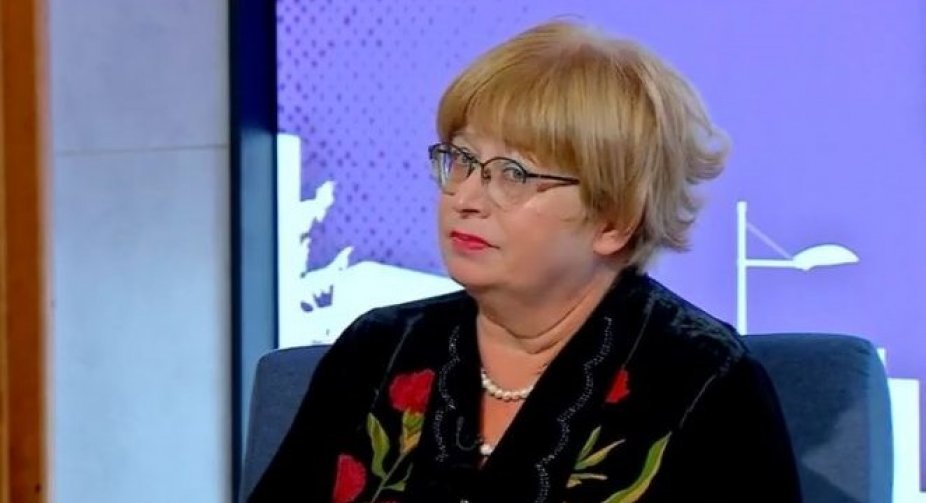
We should not claim that, during Ilia II’s tenure, the Church was free from the influence of the Russian Patriarchate - that would simply be inaccurate, Jejelava said

Author
Front News Georgia
Theologian Lela Jejelava assesses the epochal changes underway within the Georgian Orthodox Church and the process surrounding the election of the Patriarch. In an interview with Front News, Jejelava discusses in detail the interests of the Russian Patriarchate, the governing style of the newly elected Patriarch Shio III, and the geopolitical as well as internal ecclesiastical challenges facing the Patriarchate after the nearly half-century-long rule of Ilia II. She also highlights the Church’s systemic educational crisis, its relationship with the state authorities, and the difficulties of maintaining public trust.
- How would you assess the Patriarchal election process and the circumstances under which it took place? To what extent does the figure of Shio III correspond to the modern challenges facing the Church?
- In principle, nothing unexpected happened. This was the most probable scenario and one that many anticipated would unfold. During the pre-election process, we witnessed Russia’s undisguised interest in the Georgian Orthodox Church. Unfortunately, they made no effort to conceal the fact that their priority was to prevent the appointment of a candidate perceived as loyal to the Ecumenical Patriarchate of Constantinople.
If we judge by the outcome - and also take into account how quickly Patriarch Kirill congratulated the new Patriarch, Shio III - it is notable that the latter’s title was presented in a reduced form, without reference to him as Bishop of Tskhum-Abkhazia and Bichvinta. In my view, this indicates that the result was entirely acceptable for Russia.
Should Georgia begin to distance itself politically from Russia, Moscow possesses a significant lever: it can seek to keep the territories of [currently occupied] Abkhazia and Tskhinvali (South Ossetia) outside the canonical borders of the Georgian Church. I believe this is now one of the objectives of the Russian Church. Naturally, they will attempt to pursue this, although much will depend on the broader political climate.
For the time being, Russia appears satisfied with the existing status quo - both within the secular authorities and the ecclesiastical leadership. However, given the processes we are observing around Russia, it is clear that Moscow is acutely aware of its diminishing influence and the gradual contraction of its geopolitical interests. Consequently, it will naturally seek compensation wherever it finds the most fertile ground for influence.
- After the nearly half-century-long leadership of Ilia II, what will be the key distinguishing features of Shio III’s governing style? Are we witnessing the beginning of a new “era” within the Patriarchate, or will Shio III continue the line established by Ilia II?
- The status quo that Ilia II managed to establish was extremely difficult to achieve and was often the result of his exceptional personal abilities. Accordingly, the system he created allowed for a certain balance of interests.
We should not claim that, during Ilia II’s tenure, the Church was free from the influence of the Russian Patriarchate - that would simply be inaccurate. Nevertheless, both the Patriarchate and Ilia II managed to maintain a balance that largely reflected the course pursued by the Georgian state.
At one moment, Ilia II could sound distinctly pro-European when speaking about Georgia’s European identity and describing the country as part of an ancient Western civilization. Yet at another moment, we would hear him refer to Vladimir Putin as a wise man and claim that a third party had attempted to damage relations between Georgia and Russia.
When a person simultaneously declares that “Georgia belongs in Europe” and that “Putin is wise,” it becomes difficult to perceive these statements as coming from the same worldview. I do not know whether the new Patriarch will be capable of maintaining such a dual narrative while preserving the level of authority that Ilia II enjoyed. Frankly, that seems difficult to imagine.
- A change of Patriarch often leads to a redistribution of influence within the Synod. Which faction is likely to strengthen under Shio III, and how probable is the activation of internal ecclesiastical opposition?
- I think some members of the Synod - especially those who held differing positions - believe that they will be able to balance Shio III’s authority through collective, synodal decision-making. If I were in their position, I would not be so optimistic.
The new Patriarch must appoint several bishops, as six dioceses are currently vacant. Naturally, during this selection process, Shio III will favor individuals loyal to him. Those appointments will add to the votes he already commands.
It will not be easy for his opponents, because at this stage it resembles waving fists after the battle has already ended. Shio III will govern as he sees fit. The very system of which he is a part demands precisely that.
We should not be under the illusion that issues of critical importance for the Church and the country will necessarily be decided collectively. The appearance of collective governance may be maintained, but in reality these will be his decisions. He will also have the capacity to push those decisions through the Synod, because he is likely to have far more supporters than opponents.
- Recently, there has been active discussion about the Church’s role in political processes. Families of political prisoners have already appealed to the Church to intervene on the issue of pardons and to address the President. What are your expectations in this regard?
- Patriarch Shio III does not, in my opinion, possess a significant capacity for national reconciliation. Genuine reconciliation requires, first and foremost, not political expediency but a sincere internal commitment to such a process.
He will likely feel very comfortable as a Patriarch supported by the authorities and, under such conditions, may not consider broad nationwide support to be essential.
We already know his position regarding political prisoners. At a time when there were far fewer prisoners of conscience and the issue concerned Georgia’s third president, he stated that “there can be no pardon without repentance.” Yet, for some reason, I have not heard Patriarch Shio say that [ruling party founder and honorary chair] Bidzina Ivanishvili has anything for which he should repent before Georgia.
Most likely, Shio III’s position will be that these people should first repent, after which the authorities may pardon them. [Top cleric] Stepane Kalaijishvili has already voiced precisely this view, and he is a strong supporter of the new Patriarch. Therefore, this is most probably Shio III’s own position as well.
But repent before whom? Is there truly anyone in Georgia today - no matter how sinful one might consider them - who would feel remorse for opposing Ivanishvili’s regime?
- Ilia II enjoyed unprecedented public trust. What will be Shio III’s greatest challenge in preserving that trust at a time when society increasingly expects the Church to respond to pressing social issues?
- The reality is that we still do not know what kind of responses the new Patriarch will offer, what his social doctrine will look like, what foreign policy orientation he will pursue, or what his educational policy will be. Had we known these things, I could answer this question with far greater confidence.
All three areas - despite Ilia II’s immense authority - remain deeply problematic within the Georgian Church.
I can tell you that, at one point, when the Patriarch decided to admit into the theological academy individuals who had failed even the academy’s own entrance examinations, let alone the national exams, I personally expressed my outrage directly to him and told him that this should not happen.
At the time, he replied: “It is better than having these people standing in the streets.” I then asked him whether it was therefore preferable for such people to be inside the churches.
This is an extremely serious problem from the standpoint of education, and its consequences are reflected directly in the congregation itself. Many parishioners today hold profoundly distorted views about the development of our country, its future prospects, the nature of enemies and allies, and many other issues.
Yes, this is the result of the fact that the issue of education within the Georgian Church remains in an extremely critical state.
By Elza Paposhvili
Tags:
Lela Jejelava